One app for both app stores
We built it in React Native, which lets one codebase run on iPhone and Android. The app is published on the App Store and Google Play, with booking and itineraries in one place.
Travel app development case study
A travel operator wanted booking and itineraries in one app, for travelers who are often offline mid-journey. So the app had to work without a connection from the first screen. We built it in React Native for both app stores.
The challenge
Keeping data on the phone solves the signal problem and creates a sync problem.
Once data lives on the phone, there are two copies of it: one on the phone and one on the server. The app has to settle any difference between them.
What we built
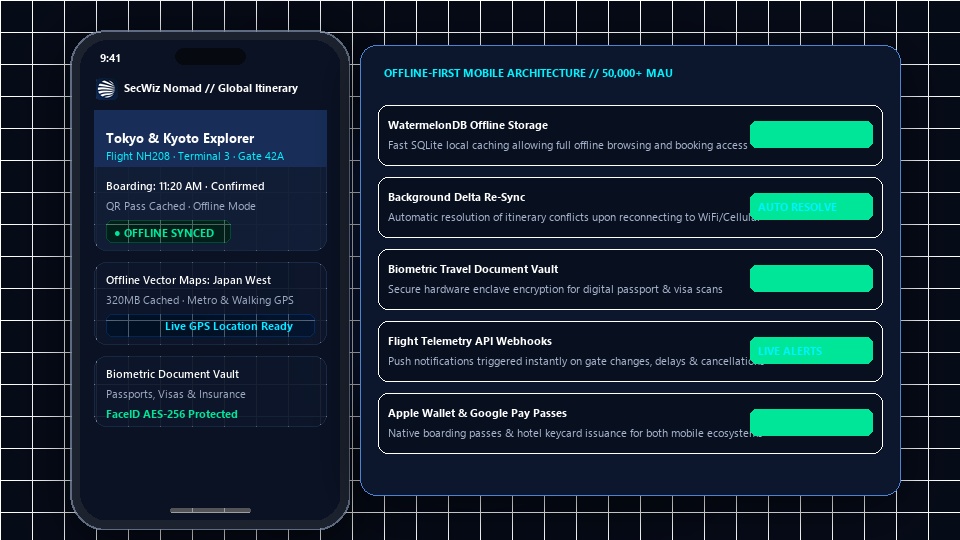
The app treats the data on the device as its working copy and syncs whenever it can.
We built it in React Native, which lets one codebase run on iPhone and Android. The app is published on the App Store and Google Play, with booking and itineraries in one place.
An offline-first data layer (the part of the app that stores and fetches data) means screens work from data on the phone, with or without signal. Itineraries, maps and documents are stored for offline use.
When the connection comes back, the app reconciles the phone's copy with the server's, including any changes made while the phone was offline.
The impact
Travelers use it every month, signal or no signal. Figures are the client's own, as reported to us.
What made it work
Offline support can't be sprinkled onto an app later. In an offline-first app, every screen reads from data held on the phone, and the server catches up in the background. That changes how each screen is built, so the decision had to come before the first one. For this operator, it did.
Related services
More case studies: the AI recruitment platform, the AI teaching platform for schools, the bank security assessment and the hotel management platform, which also has a React Native app. Or see every case study.

Let's talk
Decide on offline support before design starts. We can help you work out whether you need it. We reply within one working day.