Every document, one account
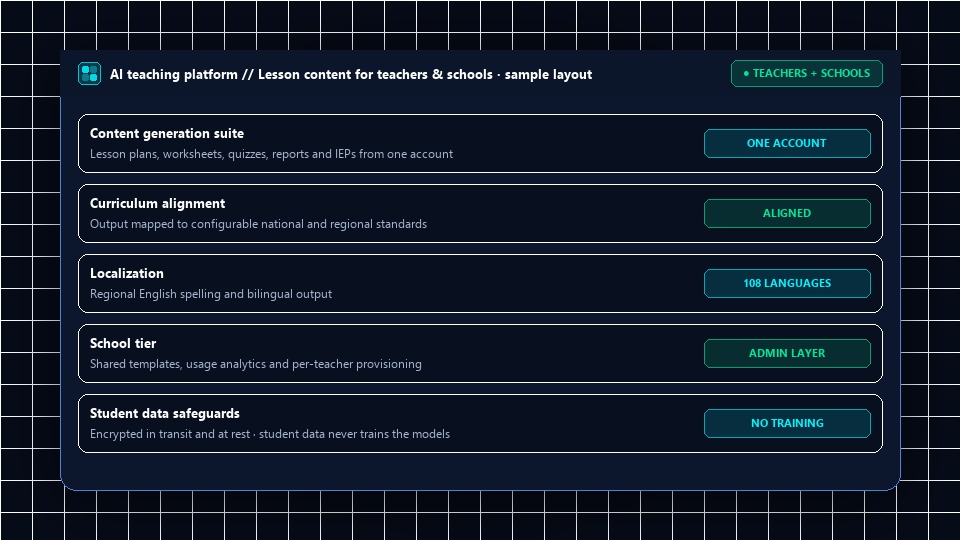
Lesson plans, worksheets, quizzes, presentations, IEPs, scope-and-sequence documents (the plan of what a course covers, in what order) and student reports. Voice and audio features help with accessibility and onboarding.
EdTech AI case study: K-12 schools
An EdTech company wanted teachers to stop losing evenings and weekends to planning and paperwork, using AI that schools would actually approve. We designed and built it, from the first curriculum-mapping prototype to a live product schools can buy.
The challenge
Teaching doesn't stop when the bell goes. Lesson plans, worksheets, marking and report writing all sit on top of classroom time. The client's early user research confirmed hours of unpaid weekend work on content that AI could speed up, if schools could trust it.
General-purpose chatbots don't fix this well. They don't know the national or regional curriculum a school teaches to. They make no promise about what happens to student data. And school leaders have no way to see how staff are using them.
So the client wanted a platform built for the job. For one teacher, it had to produce curriculum-aligned lesson plans, worksheets, assessments and reports in minutes. For a whole school, it had to be something leadership could govern.
What we built
We built a multi-tool generative AI content platform for individual teachers and whole-school administrators, on a single shared codebase (one set of code to build and maintain). Our work covered product design, generative AI engineering and the compliance work schools require.
Lesson plans, worksheets, quizzes, presentations, IEPs, scope-and-sequence documents (the plan of what a course covers, in what order) and student reports. Voice and audio features help with accessibility and onboarding.
A curriculum-alignment layer maps what the AI writes to configurable national and regional standards, so teachers rework far less of it.
Localization into 108 languages, with the dialect and spelling differences of regional English, and bilingual output.
Usage analytics, shared templates and accounts set up per teacher, which supports volume licensing and department-wide rollouts. Each school defines its approved slide and document layouts, and the AI output follows its branding and formatting automatically.
Encryption at rest and in transit (when data is stored and when it is sent), GDPR compliance and a strict rule against training models on student data, validated through an independent school-safety assessment program.
The marketing and product front end is built in Astro, a framework for fast pages that search engines read well, so a teacher who finds one tool reaches a trial quickly. Adoption analytics track hours saved, workflows generated and weekly active use, giving the client measured outcomes for sales, marketing and renewals.
The results
The platform's usage data backs up the time savings the client set out to deliver. The figures are the client's own, as reported to us.
What made it work
The product had to win teachers and pass procurement at the same time.
Schools are a hard market for anything new. Procurement moves slowly and asks pointed questions about data. Teachers drop a tool the moment it creates more work than it saves. And a teacher can love a tool and still not be allowed to use it.
We treated the independent safety assessment and the rule that student data never trains a model as product requirements from the first build. A no-training promise added after launch means explaining to every school why it wasn't there before, and that is a hard conversation to win.
We understood the trade-off between teachers and procurement going in. We had already shipped products in regulated, safety-sensitive categories. We knew how to give teachers the generative AI they wanted without cutting corners on the data governance schools require, and how to make one product work for a teacher who wants speed and an administrator who wants oversight.
Related services
Start from the question closest to yours.
More case studies: the AI recruitment platform, the patient care management app, the ISO 27001 certification program and the bank security assessment. Or see every case study.

Let's talk
Schools, clinics and banks all want to know where the data goes. We design around that answer early. Tell us about your product and who buys it. We reply within one working day.