One report, three surfaces
A single report covered the network, the web applications and the mobile app. The bank saw every surface a customer touches in one place, assessed by someone independent.
Bank security assessment case study
A mid-sized bank needed an independent security assessment of its network, web applications and mobile app before a regulatory review. Until then, its only security checks had been automated scans run in house. We ranked every finding by how exposed it really was. Two issues had high scores on paper but could not be reached in the bank's setup, and our report said so instead of inflating them.
The challenge
Everything had to be covered in one engagement, and the results had to stand up in front of a regulator.
A scanner is good at spotting an outdated component or a missing security header, and it gives each finding a general score. That score can't say which findings matter most in one bank's own deployment, or which to fix first.
The bank had plenty of scanner output. What it lacked before the review was an independent assessment of every surface a customer touches, with findings its engineers could work through in order.
What we did
We judged severity in the context of the bank's own environment, not by score alone.
A single report covered the network, the web applications and the mobile app. The bank saw every surface a customer touches in one place, assessed by someone independent.
We rated each finding by how exposed it was as deployed. Two issues scored high on paper but could not be reached in this environment, and the report said exactly that.
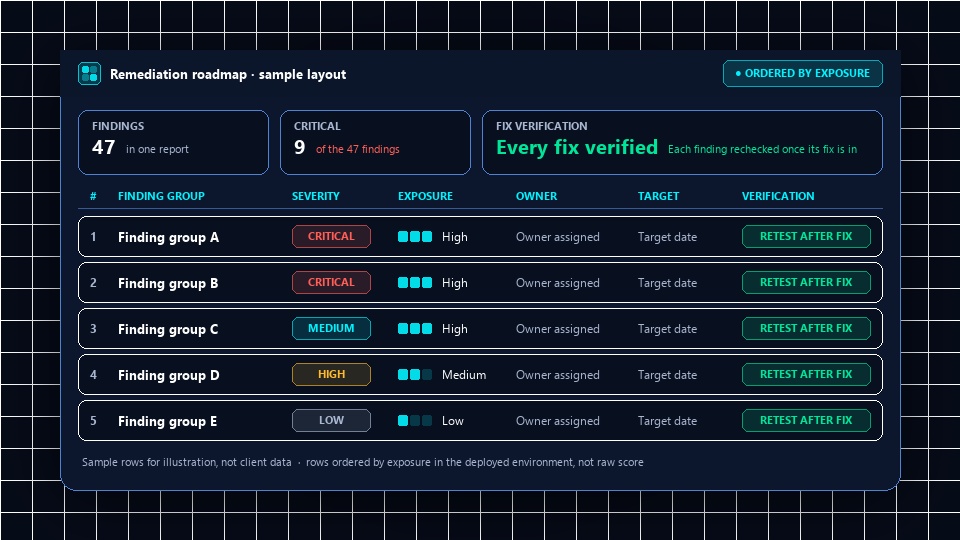
A remediation roadmap (the ordered list of fixes) put the most exposed issues at the top, so engineers knew what to fix first. Once the fixes were in, we retested every finding.
The results
Ahead of its regulatory review, the bank had an independent assessment of all three surfaces and a fix order its engineers could follow. Figures are the client's own, as reported to us.
What made it work
An honest report is one engineers keep reading.
Nine of the 47 findings were rated critical. Two more issues looked high-severity by score, but nobody could reach them in the bank's deployment, and we said so plainly.
That matters more than it sounds. Engineers sent after problems that aren't there learn to skim security reports, and a skimmed report is how a real critical gets missed.
Related services
Start from the question closest to yours.
More case studies: the ISO 27001 certification program, the patient care management app and the hotel management platform. Or see every case study.

Let's talk
We confirm which findings are real, rank the fixes by what is exposed in your own deployment and check each fix once it is in. Tell us what is in scope and when the review is. We reply within one working day.