Matching and scoring engine
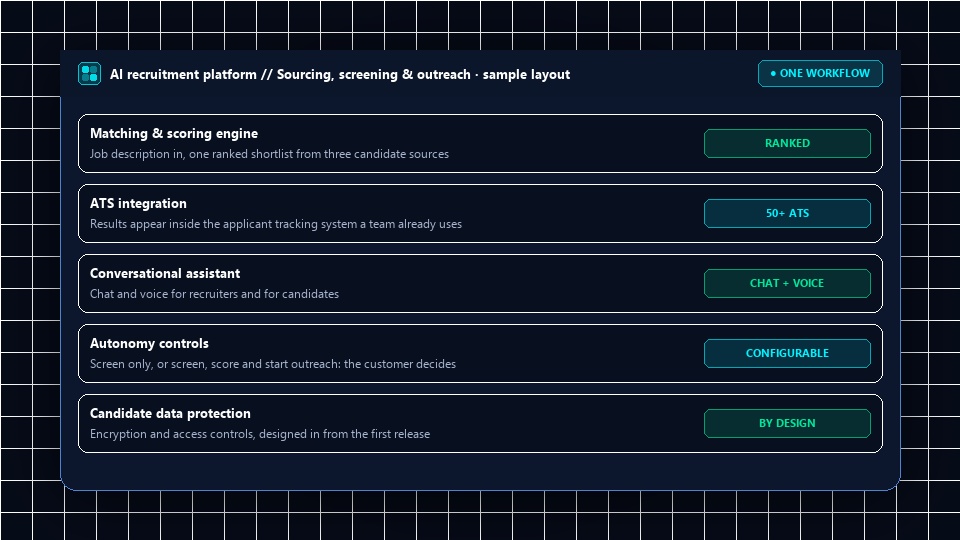
Paste in a job description and it returns one ranked shortlist, drawn from all three candidate sources in a single pass.
AI recruitment platform case study · HR tech
An HR-technology company wanted to give fast-growing startups an alternative to agency fees and weekends lost to CV screening. We designed and built the platform that does it.
The challenge
The client's target customers had just raised funding and needed to double headcount. A founder or small HR team could lose 15 hours or more per open role to CV screening, or pay agency fees out of the money they had just raised.
Agencies typically charge around 20% of the new hire's first-year salary, often $25,000 to $40,000 per hire, and send back a shortlist of three to five people.
Our client set out to build an AI hiring assistant that does what a strong in-house recruiter does. It pulls from three places at once: the company's own applicant pool, a network of pre-qualified candidates who have said they're open to a move, and profiles on the open market. Then it hands back a ranked shortlist a hiring manager can start contacting straight away.
What we built
An end-to-end recruitment platform that runs sourcing, screening and candidate engagement as one workflow each customer can configure. We took it from the first architecture decision to production launch, and scaled it after that.
Paste in a job description and it returns one ranked shortlist, drawn from all three candidate sources in a single pass.
Results appear inside the system a team already uses. There is no data migration and no change to how they work.
A web application built with the Next.js framework, with a conversational assistant for recruiters and for candidates, including voice.
The customer decides how far the AI goes: screen applicants and stop, or screen, score and start outreach, or a point in between. It is the same design question behind any AI agent that acts for a user.
Self-serve onboarding gets a new customer to a first shortlist in under five minutes, with a sales-assisted route for larger accounts. In-product analytics track hours saved and cost per hire, so the client's sales and marketing teams have measured numbers to show prospects.
An architecture designed for ISO 27001 and GDPR, the EU's data protection law, from the ground up. It has audited data handling, encryption and access controls, and runs on enterprise cloud infrastructure.
The results
Weeks of manual work and agency dependence gave way to a self-serve process that customers finish inside a week. Figures are the client's own, as reported to us.
What made it work
A ranked shortlist demos well. Whether a hiring manager acts on it is a different matter, and that comes down to trust and control.
Some teams want the AI to screen applicants and nothing more. Others are happy for it to score candidates and send the first message before anyone has looked. We don't think one setting suits every customer, so autonomy became something the customer sets. That was as much a product call as an engineering one.
Because the integrations were live at launch, customers adopted the platform without disrupting the way they already hired.
The client spoke to several engineering firms before choosing us. The deciding factor was a combination it couldn't find elsewhere.
The client achieved ISO 27001 certification and GDPR compliance, which opened sales conversations with security-conscious enterprise buyers. High-growth companies in retail, media and B2B SaaS (software sold to other businesses as an online service) now use it as a core part of the hiring stack they put in place after a funding round.
Related services
AI engineering, integrations and security built in from the start. Pick the question closest to yours.
More case studies: the AI teaching platform for schools, a bank security assessment and an ISO 27001 certification program. Or see every case study.

Let's talk
We build the AI, and we know what your buyer's security team will ask about it. Tell us what you're building and who has to approve it. We reply within one working day.