Fleet tracking
Fleet records live in the platform in place of paper, in the same system as routes and invoices.
Logistics software case study
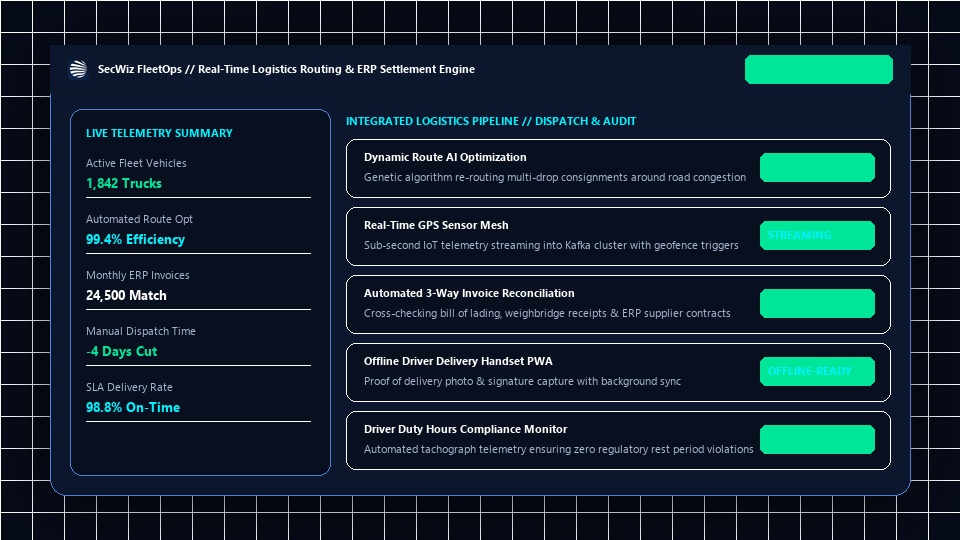
A logistics company tracked its fleet on paper, planned routes from memory and spent four days a month matching invoices by hand. We put all of it into one platform, connected to the ERP (enterprise resource planning) system it already had.
The challenge
Three core processes ran without software. Building the platform turned out to be the smaller part of the job.
The obvious need was software for work that had none. The less obvious one was risk. When route planning lives in one person's head, the business slows down whenever that person is away.
Replacing an ERP to fix invoicing would have been a far bigger project than the problem. So the platform works with the system already there. That meant integrating with an ERP nobody had documented.
What we built
The three processes went digital and connected to the ERP, instead of competing with it.
Fleet records live in the platform in place of paper, in the same system as routes and invoices.
Route optimization, where the software suggests efficient routes, is built into the platform. Planning no longer sits with one person.
Invoices are matched automatically against the existing ERP, in place of four days a month of reconciliation by hand.
All three sit in a single React platform. React is a widely used toolkit for building web applications.
The impact
Fleet tracking, route planning and invoicing now run in one system, connected to the ERP the company already used. The figures are the client's own, as reported to us.
What made it work
That is normal when nobody has documented the system you have to connect to.
Related services
Pick the problem closest to yours to see the service behind this project.
More case studies: the hotel management platform, the smart home monitoring dashboard, the travel booking and itinerary app and the AI recruitment platform. Or see every case study.

Let's talk
Tell us what you run today and what the new work has to connect to. We scope the integration on its own first, so the build estimate isn't a guess. We reply within one working day.